Last Updated March :2026
Most people finance cars they can't afford.
Listen, 80% of all new car buyers have a payment. 53% of used car buyers buy a car with a loan. So, most people have no idea how much they can afford. And the mistake follows them for years, not months. Yes, I said years.
So, today I'm going to show you how to figure out the payment the right way without fear, without gimmicks, and without living broke because of a car payment. And I'm not Dave Ramsey. I'm not going to tell you to buy a $5,000 car and never enjoy life. I'm here to talk about real life math.
How Car Payments Can Destroy Your Financial Health
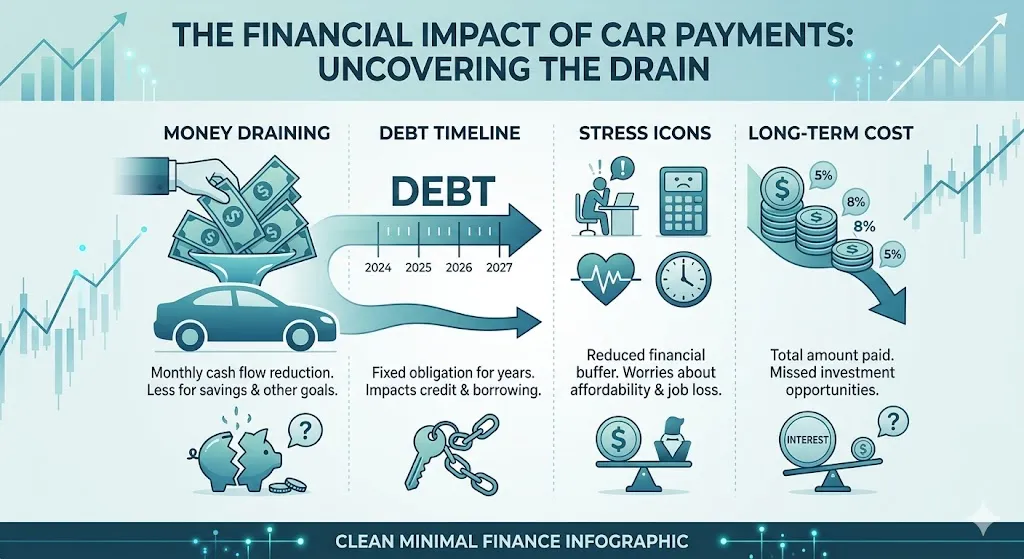
High car payments can create long-term financial pressure and reduce your ability to save.
And I think the best way that I can explain this so that you completely understand is breaking this up into a few sections.
So section one is going to be why most people get this wrong. The biggest mistake that car buyers make is simple. They walk into a dealership without a number in their head and they ask one question. What's my payment? We've talked about this in the past. The second you ask that question, you lose control because now the dealership controls four things. The price of the car, the payment, your trade, and your down payment. Notice what's missing there. The interest rate. That's not by accident. Dealers want you to focus on whether the payment feels comfortable, not how much the loan cost you over time.
And I know what the comment section is going to say. Well, if the interest rate's too high, I'll just walk. No, you won't. You are one person making a comment. I can promise you with over 10,000 car deals and hundreds of thousands of interactions and reading a 100,000 plus car deals in life in my career, people don't walk over interest rate. It doesn't happen. The economy did not slow down when our prime interest rate was nearly 8%. That is the truth.
And here's more truth. If you don't figure this out before you walk into the car dealership, they'll do it for you for the next five or six years. You should know your payment before they do. And of course, I'm going to talk about how to figure that out a little bit later in the article.
So, section two, I want to call how much payment you can afford. How much payment you can afford really depends on a few things. Your age is a real big thing. One of the biggest mistakes I see young people do is buy a car that's too expensive for them. So, where you are in life, your income, your stability, all of that matters. But we still need rules.
Here's a simple one. If you make under $120,000 per year, a car payment over $500 per month puts serious pressure on your financing. 500 is already high for most people, but in today's world, that's reality on a used car. It's well over 700 on a new car.
A safer rule is this. Your car payment should never exceed 10% of your gross monthly income and ideally 10% of your take-home pay. That's harder. It limits your options, but I promise you it'll protect you.
Banks start getting uncomfortable when your debt to income ratio hits around 40%. If you're already close to that number, you don't need a nicer car. You need less debt. If the bank sees risk, you should, too.
On section three, we're going to name it down payment is protection, not a dealer trick. And I always get a little bit of flack when I talk about down payment. I want to talk about down payments because this is where people get emotional. A down payment is not about helping the dealer. It's about protecting you.
How Much Car Payment Can You Really Afford?
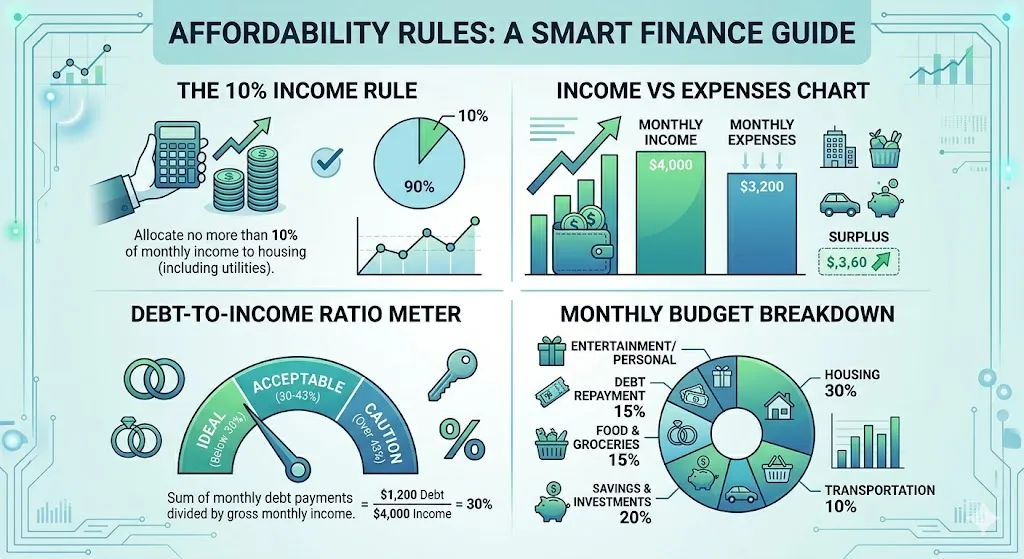
Use the 10% income rule to keep your car payment affordable and sustainable.
When you buy a car, you're planning that you can afford this vehicle for five, six, or even seven years. That assumes life stays perfect. And of course, we know life doesn't. Jobs change, people relocate, families grow, commutes change, stuff happens. Money down gives you an exit if life does change.
Here's my rule. For every $15,000 of vehicle value, you should put down about $4,000. That's roughly 25 to 30%. And I've seen comments all the time that people just laugh about me saying that. So, a $30,000 car, you need about $8,000 down. A $15,000 car around $4,000 like I mentioned. But the reality of it is is most people put a,000 down. It's insane.
And you have to remember this. The second you buy a car, you add taxes and fees. In most states, that's 6 to 7% right away. If you don't put enough money down, you're starting that loan upside down. For example, if you buy a $15,000 car, 7% sales tax is about $1,50. If you only put $500 down, you're already $550 in the hole on day one. And of course, I'm not even talking about dock fee, dealer add-ons, title fees, stuff like that.
If you don't have enough equity, you don't have any flexibility either. And again, this is something I've seen thousands and thousands of times over my career that all of a sudden, just one example that I see so many times, oh, we're having a baby, we're having our first baby, we're having our second baby, and our needs change because we need a bigger vehicle. But I bought a vehicle a year ago. I didn't put any money down. Probably rolled some negative equity on this loan. And now I'm $10,000 flipped. And you know whose fault it is? The dealers. It's never my fault as a consumer. It's always the dealer's fault. It always gets blamed on the dealer.
So, this is where a little trick comes in for section 4, and it's a payment frequency trick that saves you thousands. This is one of the strongest tools that people ignore.
My daughter bought a $15,000 car. She did a 60-month loan, and her interest rate at the time, this was a good rate, was 6.64% interest. instead of paying monthly, she went to the extreme of what I've taught my kids and she paid $100 every single week. So, she made four car payments a month rather than just one.
Also, she had another car that she almost had paid off. So, when that payment ended, she rolled that $400 straight into the new car. So, instead of paying around $400 per month, she was paying the equivalent of $800 per month once that car payment ended. So she was paying $200 a week every single month. So she paid that car off in under two and a half years and she saved herself $2,000 in interest.
So I just kind of tell you what would you do with $2,000 right now instead of giving it to the bank? What could you do with it in your pocket? Invest it. Go spend it on something like a game. I don't know. But what could you do with $2,000 right now?
Why Down Payments Protect You From Financial Risk
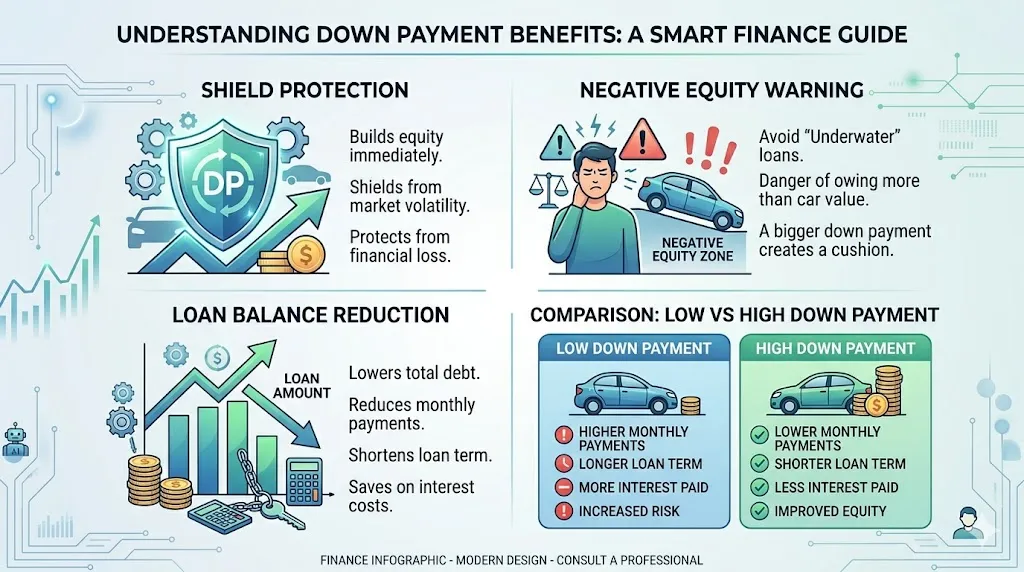
A strong down payment helps you avoid debt traps and stay financially flexible.
So the number one rule on this is we do not let the dealership set up your bi-weekly payments for you. You do this on your own. Every dealership out there will say, "Oh, hey, we can do this for you." That is going to generally speak cost you anywhere from $300 to $900 over the life of your loan, which is most of your savings traditionally.
So, your loan uses simple interest. It's calculated on your daily balance. Lower the balance faster and you pay less interest. It's math. So, even $20 to $50 extra per payment adds up fast.
Section five, I'm going to call the Joneses are broke. Stop trying to impress strangers who don't care about you. 67% of Americans live paycheck to paycheck. That means two of every three people giving you advice online are struggling. If someone isn't paying your bills, their opinion doesn't matter. So do what protects your family, not what impresses someone you've never met.
I'm telling you, I sell a car to XYZ on Main Street. I will sell two to three more cars on that same street if I do my marketing right. And I can tell you with over 4 million followers on social media, I've done my marketing right. I used to send out handwritten letters that your neighbor just bought a car. If you're interested in buying a car, too, come see me. I did this back in the early 2000s with this huge book that showed me everybody's name and address. And I would go to that street and send out letters to every single one of those people. It happens today psychologically and with social media. So, don't try to keep up with the Joneses.
Section six. I've always believed this. It's not something new that since I own a used car dealership is that I think used cars are smarter today. Ignore the internet noise. People don't go online to say I drove my car today and it worked great. They go online to complain. It's why there is a car complaints.com and not I love mycar.com. Right?
So when you see a new vehicle advertised at $28,000, traditionally that's a base model price. The vehicle shown in that commercial is usually loaded with options and costs much more. American buyers demand higher trim levels, bigger screens, more tech, heated seats. That demand pushes real world prices way much higher.
So, a real life scenario that I did here, I purchased a 2018 GMC Sierra SLT with cloth seats. Only had 75,000 mi. I had that car for almost a 100 days, which is ancient for me because I sell my cars typically 18 to 24 days. That vehicle was sat there and 23 other trucks around it all sold for at or above the price that I had on that car and with much higher miles because they all had leather. I had two trucks that I had cloth here and they both sat here forever. I just recently traded for a Silverado double cab with cloth seats. I gave it 10 days and at day 10 I put leather in it. The day I put leather in it, uploaded all the pictures, updated the description, the next day I got a lead and sold it. And they did not see that vehicle prior to having cloth. So that tells me that people in the real world are wanting loaded up cars. And that's why you see them all on dealership lot with loaded up price tags.
Smart Payment Strategies That Save You Thousands
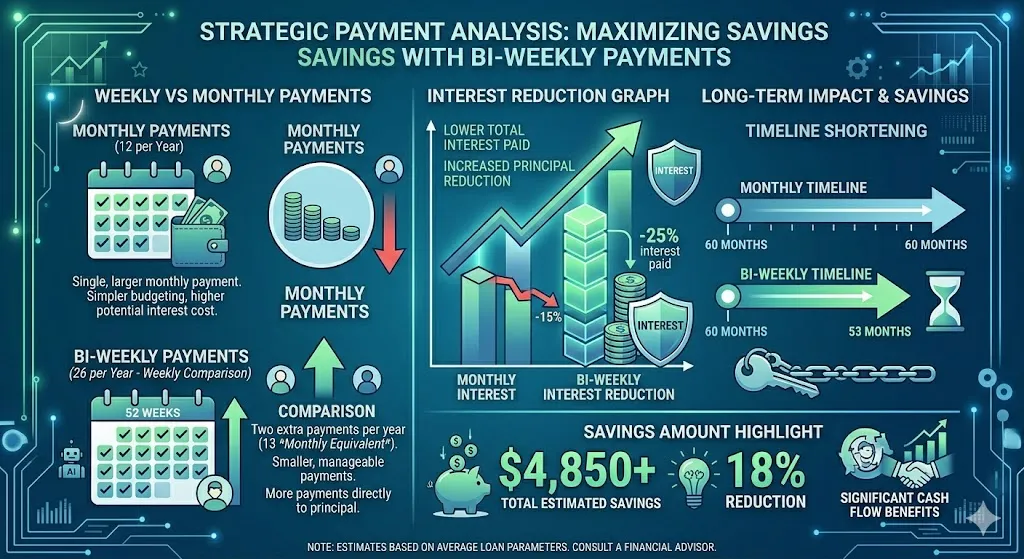
Paying more frequently or adding extra payments can significantly reduce interest costs.
And so you have to remember once you add taxes and fees, the out the door number is going to be well more than $35,000 that you see on a car today. So now you compare that same vehicle with 4 to 6 years old. That's 20 to $25,000 range. That payment gap is why used makes sense for most budgets. And it ties back into keeping up with the Joneses. Hey, let that neighbor go buy that $70,000 truck and have a $1,400 car payment when you go buy a $30,000 truck and have a $600 car payment. That is going to make much more sense to probably 87% of Americans because you're living paycheck to paycheck.
Section seven, we're going to come to the computer because you need to know how to calculate your payment before you shop. Before shopping, you need a few numbers. And you can get all of these worksheets on chevydude.com. But what we're going to go to is mikecartore.com. And if you look right up here at financing, you're going to see loan calculator. You click on that and that's going to give you what you need to know.
So, first and foremost, you need to know the out the door price. You need to know what your real down payment is, your sales tax rate, interest rate based on credit, loan term, and your payment frequency. And what I like to do is get that out the door price from the dealership prior to you doing anything you before you go into the dealership, before you commit to buy it, anything like that.
So, you can do this a couple different ways. So, say you got that out the door price from the dealership and it's $21,548.66. You can say you're putting down $4,000. You don't have to worry about sales tax. And I think a good rate on a used car to figure is 8% and 60 months. And on a new car, you can go 6%. Again, this is just forformational purposes at home. Once you get preapproved, you can come in there. And so now you're looking at this $21,000 out the door car at 356 per month.
So let's say that you have a $19,500 car. You have 4,000 down. you have a 7% sales tax. Look at that. 3.42 per month. So, pretty pretty accurate of what you're doing. So, even if you want to figure your sales tax and stuff like that, but the reason why I want to say out the door price on this is because in some cases dock fees are taxed. If you buy an extended warranty, it's taxed. Taxes vary on what how they're calculated state-tostate. So, you need to be careful.
But let's say you're looking at a $45,000 car and you're going to put 4,000 down, 7%'s tax rate. Look at that payment, $8.96. You're putting eight grand down, $815, right? So look how much money that saves you per month.
It's always a good rule of thumb that $20 for every,000 you finance is what it's going to cost you. So again, a $40,000 car with no money down, that's going to be an $800 payment. A $20,000 car, expect roughly a $400 monthly payment.
Common Car Buying Mistakes That Cost You Thousands
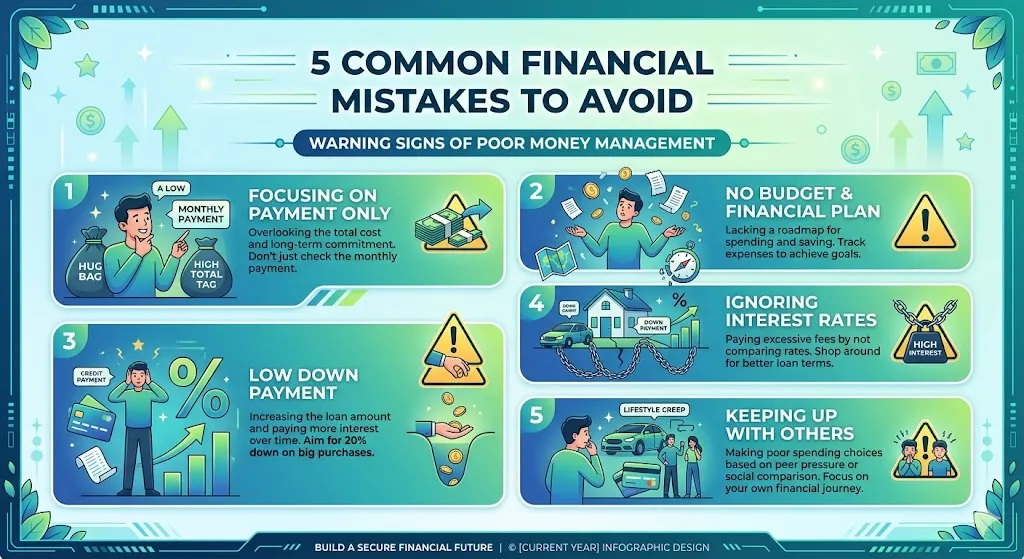
Avoid these common mistakes to stay in control of your car financing decisions.
So, calculate this at home, not at the dealership. Or if you're at the dealership, have a payment calculator. It doesn't have to be mine. Have a payment calculator available so that you can figure your own payments. Because when the dealership shows you payments, they are going to be inflated to protect themselves for various reasons. And the biggest reason is is so that way they can sell you product in the FNI office.
So, with all of this knowledge, this is exactly how you need to do your car payments. And you need to think about it. Who are you going to make rich? You're either making the bank rich or you're making yourself rich.
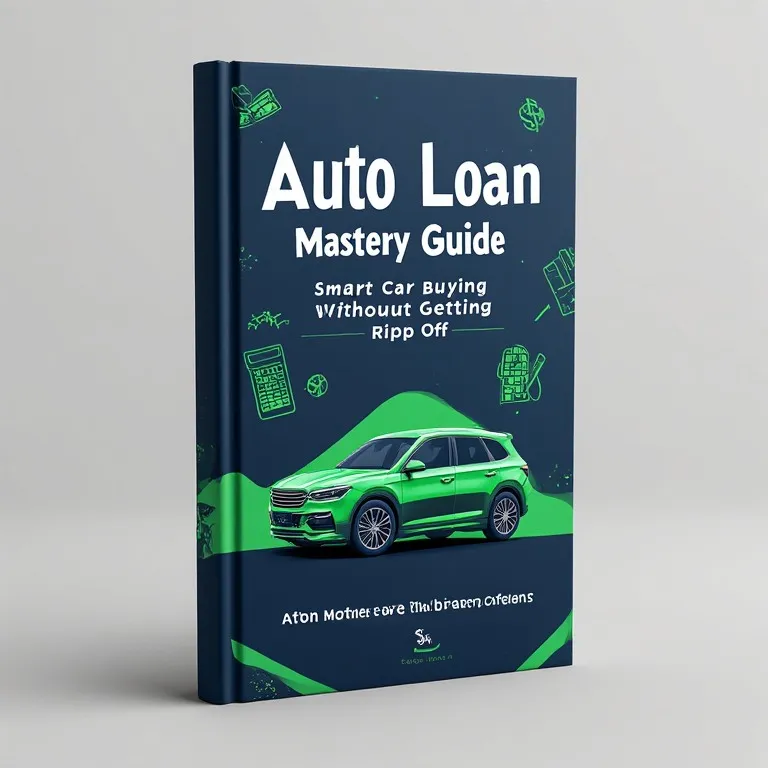
📘 Auto Loan Mastery Guide
Everything you need to know before signing any car loan
20+ Chapters • Instant PDF download
$4.99$24.99
- ✅ Why financing a car can be smarter than paying cash
- ✅ How much car can you REALLY afford? (Avoid being house-poor on wheels)
- ✅ Boost your credit score fast before applying
- ✅ New vs Used Car Loans – Which one saves you more?
- ✅ Dealer financing vs Bank/Credit Union – The hidden truth
- ✅ Fixed vs Variable rates explained simply
- ✅ Complete step-by-step car buying process + pre-approval checklist
- ✅ Hidden fees, dealer tricks, negative equity & Gap insurance explained
- ✅ Leasing vs Buying – Clear comparison with pros & cons
- ✅ How to negotiate the best deal and refinance later
- ✅ Plus: First-time buyer checklist, documents needed, and final tips to avoid buyer’s remorse
🔥 Perfect for first-time buyers and experienced drivers who want to save thousands
🛒 Buy Now – Instant Download🔒 Secure checkout • Lifetime access • 30-day money-back guarantee
Try Our Calculator
Use our online calculator to estimate results instantly.
Open Calculator