Last Updated March :2026
Dealers love firsttime car buyers. Even if you bring backup, they're still going to win. Car dealers and car salesmen love firsttime car buyers because you are prime target for bad financing, overpriced vehicles, and shady deals. So, I'm going to break this article into two parts. First, for buyers who are doing this solo, you do not have a co-signer. And then the second part of the article is with a co-signer. So follow these exact steps to avoid the traps that screw over 90% of first-time car
buyers. So no cosigner. Here's step number one. You've got to do your research in vehicle selection. Start by choosing the right car for your situation. Not the one that looks best on Instagram or impresses your friends or neighbors. Use my spaced method. Safety, performance, appearance, comfort, economy, and dependability. You've got to remember this is your very first car. And as a firsttime buyer, economy and dependability should be your non-negotiables. This means fewer surprises, fewer breakdowns, and lower
Step-by-Step Car Buying Process for First-Time Buyers
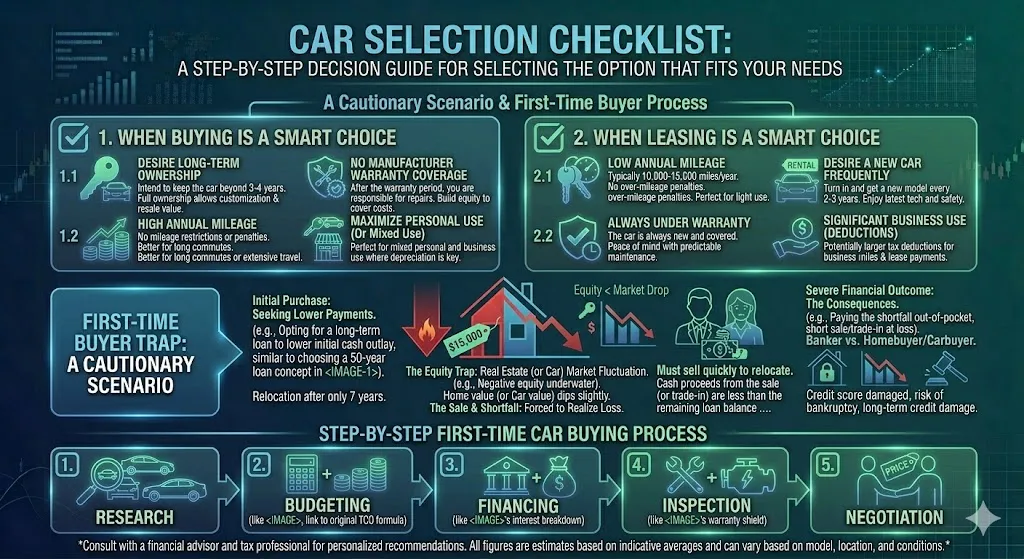
Follow a structured process to avoid costly beginner mistakes
operating cost overall. Again, as a firsttime car buyer, I'm assuming you're somewhere between 18 and 25. You don't have the finances of somebody out there, your parents, your friends, whatever the case may be. You don't have that availability to you. So, you have to go basic and you have to break it down to do I want to do new or used. Let's be real. There's a lot of pros to a new car. We got full warranty. You've got the latest tech, which this one gets firsttime car buyers. I've got to have a
backup camera. I've got to have USB. I've got to have USBC. I've got to have yada yada yada. CarPlay, right? There's so many things out there for the latest tech that could cost you a lot of money. So, the latest tech is definitely a big pro for a brand new car. They often have best interest rates as well. But with the new car comes with cons. So you have higher upfront cost. You have faster depreciation. You lose your first 50% of your depreciation in the first couple years. So why do you want to take that
uh out of your pocket instead of investing it or having it for future use? And you're obviously going to have higher insurance and license plates depending on your state as well. My advice for first-time car buyers to determine your wants and needs is aim for a used car in the 13 to $15,000 range. If you're under a $10,000 price point on a car, you're dancing with a lot of risk. Today's market under $10,000 car is what the $5,000 car was back in 2015. You're going to have breakdowns, repairs, and possibly even
end of life issues on that car. So, if you're spending your money, you're making payments, and the car completely kaputs, it puts you in a really bad situation. So, that $13 to $15,000 range seems to be a very good range for first-time car buyers. Number two is you've got to set a real budget. And if you notice with number one, we're not at the dealership. We're not contacting the dealership. All of this stuff is done at home. You don't budget based on your monthly payment. That's what they want
you to do. You need to budget based on total cost of ownership. In my opinion, you use the 2410 rule. This is something that's been very popular over the last 5 or 6 years that people are talking about it. 20% down and this is your out the door price, not just the sticker price. A 4-year loan max, not a 60 or 72 or God help you 84 or longer months. I've seen that on new cars and some used cars. And then 10% of your gross monthly income for your car payment. So, if you're making $2,000 a month, that means you
can afford a $200 car payment. And that's very tough to do in this market because a $200 car payment, as you know, with my analogy, $20 for every,000 you finance is a $10,000 car. It's going to be very, very, very tough to do. But that's why I said the $13 to $15,000 range, and you should be there. People always say it's not that big of a deal for the budget, but I'm telling you, it's super, super huge. When the car breaks down or they try to trade it in later, they blame the dealer, and that's
just not how it works. If you budget this correctly, you're not going to have issues down the road because again, you're young. There's a lot of change going on in your life in the future. Assuming again, back to what I assumed earlier on in this article is that you need to make sure that you don't overextend yourself and then be like, "Oh crap, I can't afford this $800 car payment because I'm changing jobs or I'm going to start driving more or whatever the case may be." And then you're behind
the eightball trying to trade in something. you find out that you got 10 grand negative equity and you can't get rid of that car and you can't move on to better things in life. So stick to the low low payments and budgets on your very first car. The third thing is you've got to get your down payment. Banks will not cover your taxes and fees. You have to bring money to the table. A solid down payment is your ticket to approval and a decent rate. 20% is ideal. It's almost the minimum
nowadays what I see with people out there. The more is better. If you got 30, 40, or 50%, that's awesome. You can now look at, hey, I'm gonna go to a $20,000 car. I got 10 grand down. You're financing 10 grand. You have $200 a month car payment, right? So, that is amazing thing. And a bank's ability to make an approval gets really distorted when they have a 50% loan to value rating on that car. And the way most banks determine loan to value is based off of JD Power, formerly known as NADA,
New vs Used Cars: What First-Time Buyers Should Choose
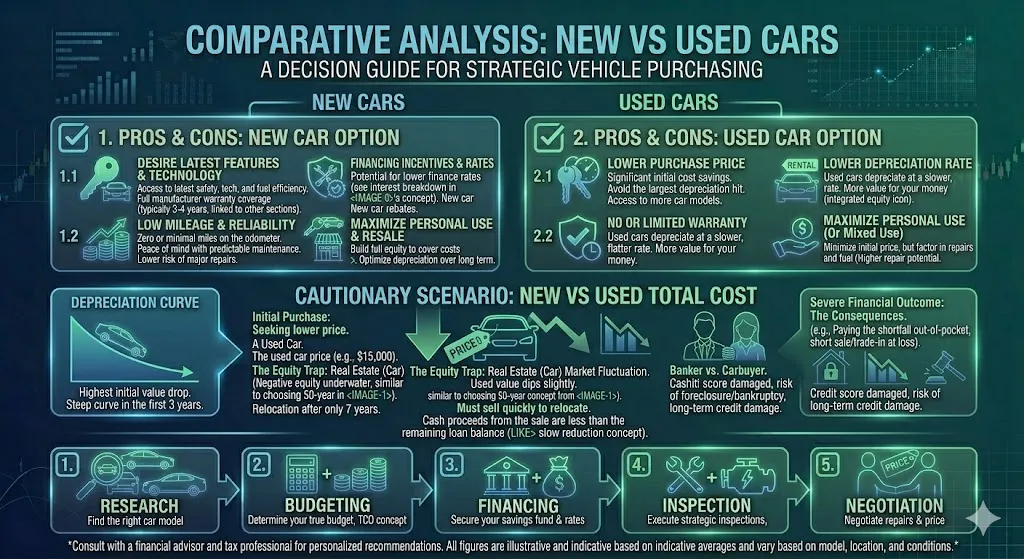
Used cars often offer better value and lower financial risk
trade-in value or retail value. That's depending on the bank. And then some banks have their own ways of figuring the value of the cars without that big down payment. You're looking at subprime rates or straight up denial. So skip the Xbox, get off Door Dash, and stack your cash because this is super super important to get this going on. Number four is work with a local bank or credit union. I didn't learn this until I started my dealership here at Mike's Car Store. And I have a real life scenario
that I'm going to share with you uh about this. Here's where 99% of the people go wrong. And they go straight to the dealer for financing or they go straight to their big bank, a PNC, a Chase, a Wells Fargo. None of those banks care about you because you're just a number to them. I learned that as another thing I learned with this dealership. As I was with PNC and when I wanted to buy this dealership, they told me they don't work with dealers. And I'm like, "Excuse me? Do you see how much
money I have in your banking system? Like, yeah, we see that, Mr. Davenport. You pay cash for for this, but yeah, we don't loan banks to uh credit car dealers. I yanked my money out. Never heard a word from them. So, instead, walk into a local bank or credit union. If you can do this really super early on in life, 14, 15, 12 years old, certainly at 15 and 16 years old with your parent getting you a checking account or a savings account there. This is huge. A local bank or credit union is not just
about numbers. It's about community and about building relationships. So, every time you have a deposit, walk into that bank or credit union and give that deposit to them. Introduce yourself professionally to the tellers or the manager there so they know who you are. If you're 15 years old doing this and say, "Hi, Debbie. Hi, Ron." And they know who you are. When you come to them and say, "Hey, Debbie, Ron, I've had my checking account, my savings account since I was 12, and I got five grand in
there, but I need to borrow some money for a car loan." You're working a relationship there. You're not working a number. They know who you are. So, open that checking and savings account early, early early on and do it at a local bank or credit union. Another level 500 IQ strategy is is attend workshops or community events they do. Very few people show up to these things. So, if you're the one that's always consistently there at a young age doing some community service for yourself or
bettering yourself for future endeavors, this is going to give you an in with the bank as well. Follow and engage with them on social media. Write a fivestar review for them. Look at your local banks and credit unions and see how many five-star reviews they have. See how many reviews they have in general. They don't have a lot. Banks don't focus on this for whatever reason. Every bank out there that I see that's local and small just doesn't have a whole lot of reviews. I'm talking less than 20. It's
insane. So, go write a fivestar review right before you walk in next time and they'll thank you for it and they'll remember that in a big way. You're not just a number to them. You're a human. And that means lower interest rates, more flexible terms, first-time buyer assistant programs, ability to refinance later once you approve yourself with them. Let's say you do get a loan with them and it's 18% interest. Well, after 6 months, you could go back to them and say, "Hey, I've been paying my car on
time, blah blah blah. Can we refinance this to a lower rate?" That's a possibility. There's literally thousands and millions of ways that you can get creative of building a relationship with your local bank. So, I want you to drop in in the comment section of something that you've seen or done to build a relationship with your local bank. Number five is you only negotiate the purchase price. Here's where the first-time buyers blow it. And they blow it so big. They go into the dealership
say, "Hey, I'm looking for something around 350 a month." Stop. Please stop. You just told them how to screw you over. You gave them a blueprint and saying, "Hey, if we can get them to 350 a month, they'll buy now." And that's when the car dealerships start working their car deal. I say it all the time, their car deal. They're not working your car deal. They're not working for you. They're working for themselves. They are making themselves a commission. Because
every single person that you talk with in a car dealership, if it's parts, if it's service, or certainly sales, they're all commission salespeople. So, always negotiate the total purchase price, not the monthly payment. Dealers know how to bury money in long-term loans, hidden fees, and of course, you always got to negotiate from home. That's your turf. If you think negotiating their office gives you leverage, you're already lost. Once again, they call it home field advantage
for a reason. Who's on whose turf? Who's at home? And who's got the advantage? You certainly being inside of a dealership, it does not give you any advantage regardless of what they tell you on the phone, it gives you no advantage. Get everything in writing. If they say it's not our policy, I've got techniques in other articles that I'll publish at the end of here that you can read, but uh you've got to get everything in writing. So, hold them accountable. Number six is car
The 20-4-10 Rule: Smart Budgeting for Your First Car
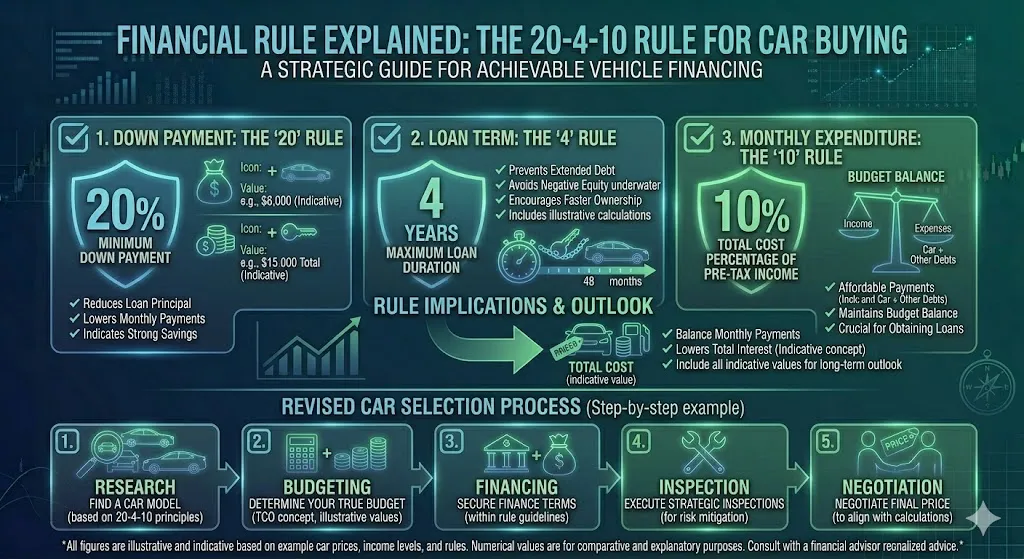
Use proven budgeting rules to stay financially safe
inspections and test drives. This is where a lot of first-time buyers miss the mark and they set themselves up for buying a bad car and they're stuck in a monthly payment or they've wasted their savings on a car that is a limited. Before you sign anything, do two things. First, we get a third party pre-purchase inspection, a PPI. If they say no, walk away. Don't do it. It's not worth it. I know you just invested this time of negotiating with the phone and all that stuff, but if they won't do a PPI, walk
away. They're hiding something. I promise you 100%. I have a car deal right now that someone's got a car in stock for 10 days. They've got it priced $1,500 under market value. They told the customer, "Hey, we'll we'll knock another 500 off." And why are they selling this car for $2,000 under market value and they've only had it for 10 days. They They know something's wrong with this car. I promise you, it's been in a moderate accident. They've seen things, they've done things, they don't
like something, so they want to get rid of it as fast as possible. And what's the fastest way to get rid of a car you don't want? lower the price, make it enticable to the customer because they're only going to focus on price and monthly budget. And that's what this customer is doing and they're making a big mistake. The second thing you have to do once you know that you can get that pre-purchase inspection done is test drive the car for 30 minutes. Don't let them shove you on a 5minute loop.
Drive it through a full driving cycle. A full driving cycle is very wide range on what happens for the manufacturer's processes. But if you get out there and drive for 30 minutes, this is going to go through cities, highways, turns, braking, parking. You're going to get through all of that stuff, and you're really going to find out if that car is good or not. I've got a article on how to test drive a car. You can go read that. And so, the reason we want to test drive for 30 minutes is you're looking for
hidden issues that won't show up in a quick lap around the block. Check engine lights come on after a second or third time of a car starting, going through a driving cycle. How many times have you heard a customer say or your friend say or whatever the case may be, "Oh, I bought the car and the next morning the check engine light came on." That's not the dealership's fault. That's your fault. You didn't test drive it long enough. If you would have test drove it for 30 minutes, that check engine light
wouldn't have came on the next morning. Or, hey, I bought a car and I got down a mile down the road and the check engine light y. Yeah, because you started the car a second time and started driving. This is what a drive cycle is. you have to drive a long period of time because that's when the check engine light's going to come on. All right, so that brings us to part two. If you're buying with a co-signer, now people just think out there that, oh, I've got a friend or a mom or a dad or a cousin or uncle or
whoever. I got somebody with a 750 credit score and uh I'm going to be able to get this. And you might think this to yourself, oh, I've got Credit Karma. It says I have a 750 credit score. So, let's say you do have a co-signer or you personally have a 750 credit score. It helps, but it don't assume you're in the clear. Just because you have a 750 credit score doesn't mean that you can buy anything out there. You have to choose the right cosigner. It's not just about the score. It's about the history.
Biggest Car Negotiation Mistakes First-Time Buyers Make
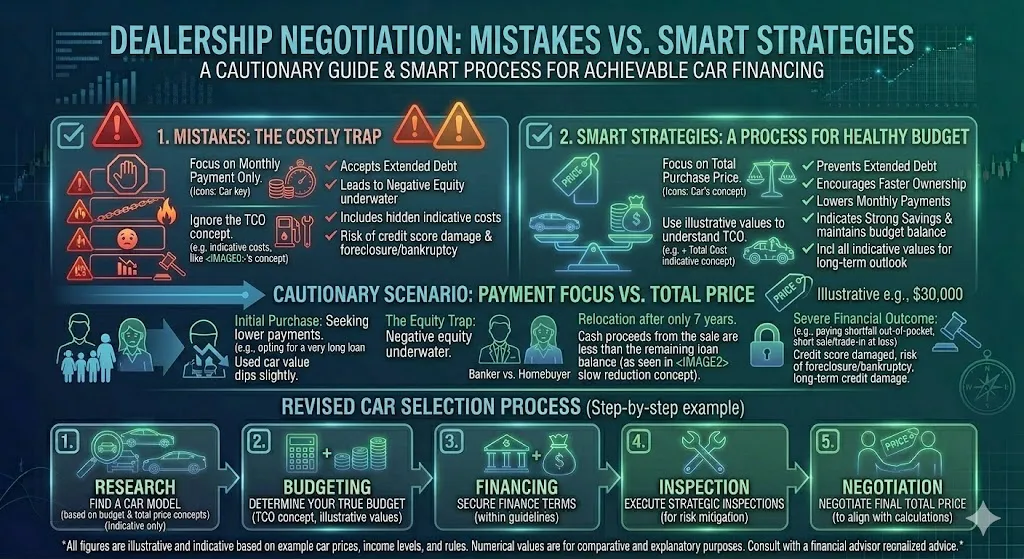
Focus on total price—not monthly payments—to avoid overpaying
Your cosigner must be well established. Just like you have a 750 credit score, you have to be well established. If you've got three things on your credit card that are $300 credit cards that you've paid with no problem for a year, great. You got a 750 credit score, but you don't have any stability. you don't have any proof that you can actually take on a loan and pay it back. Having three credit cards with $300 to $1,000 availability and balance and you haven't used it, that doesn't do anything. It
just gives you a fake credit score. So, your co-signer has to be well established. And I'm sure you're like, "Well, what does well established means?" That means that they either have or had car loans before. They've successfully paid them off. I personally think that if your co-signer has not paid a car loan off that this chalk is much, much lower. not impossible, but much much lower. So, if they've had a car loan, so so maybe for four years and it was a 60-month car note, then they've
only got a year left. So, that might be a good possibility that you'll get approved with them. So, this really means that they've got car loans that they've had paid off. They've got a mortgage that they've successfully paid over numerous years, not just 6 months. They've got a consistent credit profile, not just one or two good lines. So, the best co-signers are parents, grandparents, aunts, uncles, and maybe siblings. If you're married and your spouse has a 750 credit score plus at
least one paid off auto loan or a loan nearly paid off, you're probably good as well if you have that 20% down. For example, my daughter was married for a little over a year. Her husband has never had a car loan, but she has excellent credit based off of what I've done for her in the past, and she was less than like a year of her Volkswagen Beetle that she has getting paid off. and she's had a car loan before that as well for 6 months because I was on it as a co-signer and we had refinanced it,
right? So, the lender approved those two together with a great rate with no issues because she had two car loans that she had already paid off or close to paying off. So, it's it's a huge huge uh plan to use someone like that. But also a huge bonus tip is the same household is a big win if your co-signer lives with you. Lenders love that. It reduces risk and it makes approval easier than a household that uh is not the same or in different states or stuff like that. And I said this at the
beginning, I get that so many people out there want to have all these cars and cool cars, especially guys. Uh we grow up thinking, hey, we want the coolest cars in the world when it comes to us driving. Um now we want to have the cool cars because of social peer pressure. Don't fall for that peer pressure. I can give you a prime example. Uh I had a kid, 18-year-old kid. Mom and dad would not cosign for him. He had $4,500 down. We had a 1999 Corvette that would have been very budgetable for him because it
Car Inspection and Test Drive Checklist for First-Time Buyers
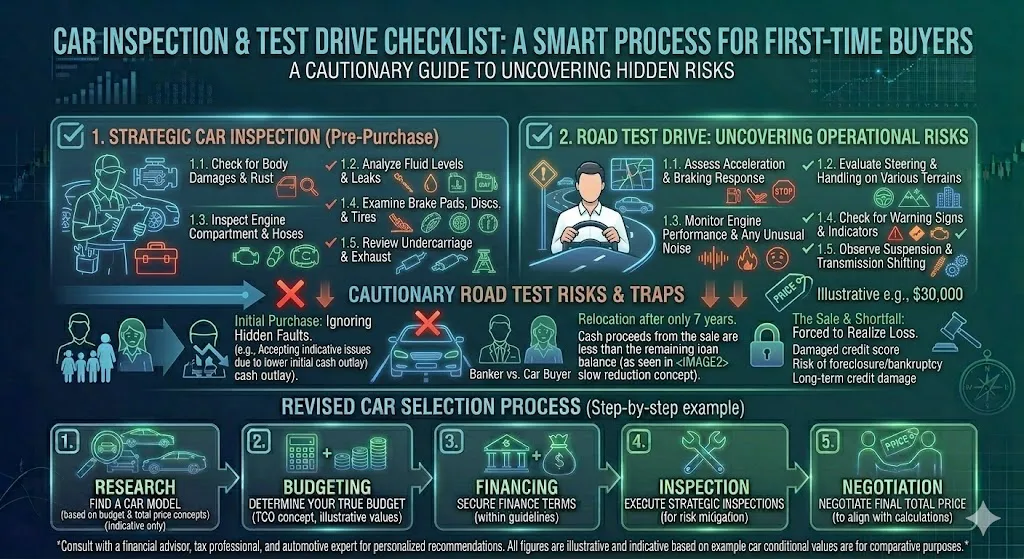
Always inspect and test drive thoroughly before committing to a car
was 20 grand. Uh with four grand down, he'd have probably had a $300 car payment if the banks would have gone 60 months on that. They're not going to go 60 months on a 99 Corvette with 100,000 miles for 20 grand. So, I got him approved on something else. It was like an Acura MDX. I'm like, "Hey, great news. I got you approved on this, but not the Corvette." He says, "Nah, I'm not an accurate type of guy." And I'm like, "What are you driving now?" "A
motorcycle." Guess when it was. It was June, right? So now, uh, 4 months goes by. We're like in September, October time frame. It started getting cold. He calls me back and says, "Hey, man. I need a car really, really bad. Uh, it's getting cold. The bike's not going to work this winter." I'm like, "Oh, sweet. Um, do you still have your $4,500 down?" No, man. That's long gone. I couldn't get him approved without the $4,500 down. He spent all of his down payment.
And guess what? He's either riding a bike, walking, or taking Uber everywhere. So lower your standards when it comes to your first car. You got to remember that this is temporary. This isn't something forever. This is something that is just going to get you your A and B transportation so that way you can elevate yourself to the next level of your life. Most likely you're young like I mentioned and so this is just something temporary that's going to help you achieve big goals in the
future.
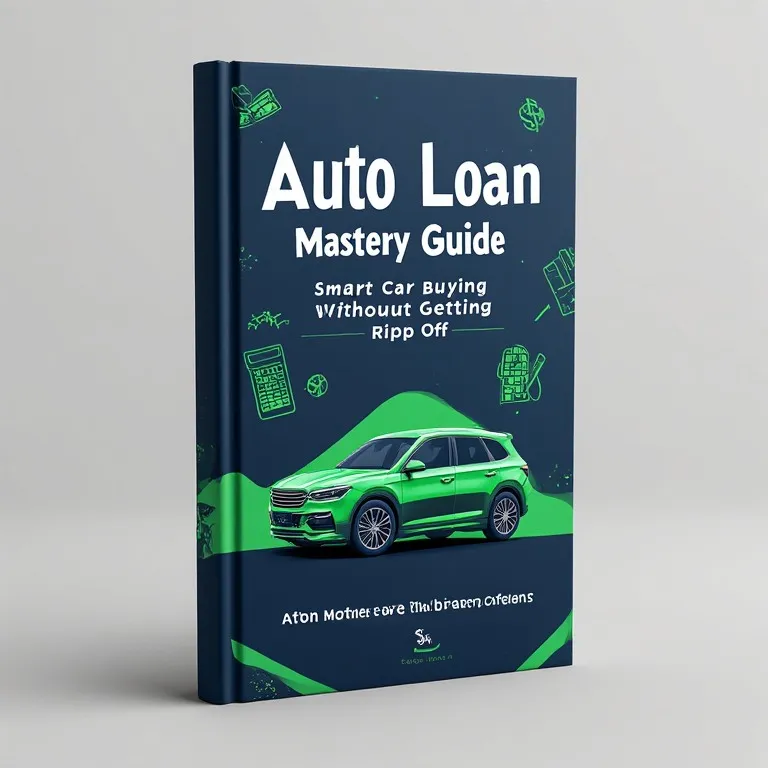
📘 Auto Loan Mastery Guide
Everything you need to know before signing any car loan
20+ Chapters • Instant PDF download
$4.99$24.99
- ✅ Why financing a car can be smarter than paying cash
- ✅ How much car can you REALLY afford? (Avoid being house-poor on wheels)
- ✅ Boost your credit score fast before applying
- ✅ New vs Used Car Loans – Which one saves you more?
- ✅ Dealer financing vs Bank/Credit Union – The hidden truth
- ✅ Fixed vs Variable rates explained simply
- ✅ Complete step-by-step car buying process + pre-approval checklist
- ✅ Hidden fees, dealer tricks, negative equity & Gap insurance explained
- ✅ Leasing vs Buying – Clear comparison with pros & cons
- ✅ How to negotiate the best deal and refinance later
- ✅ Plus: First-time buyer checklist, documents needed, and final tips to avoid buyer’s remorse
🔥 Perfect for first-time buyers and experienced drivers who want to save thousands
🛒 Buy Now – Instant Download🔒 Secure checkout • Lifetime access • 30-day money-back guarantee
Try Our Calculator
Use our online calculator to estimate results instantly.
Open Calculator