Last Updated March :2026
When you're buying or leasing a car in 2026, what people are getting wrong is that the price that you see is not your true cost of ownership. To make the best financial decision, we need to run the numbers on what each year of car ownership will actually cost you for both buying and leasing. As of right now, the average car payment for a new car in America is over $750 a month or $9,000 a year in just payments. And that doesn't even include insurance, maintenance, and gas. And while interest
rates have come down a little bit from 2024, which was the last time I made this type of article, cars are still expensive. For today's article, we're going to reference a Toyota RAV 4 Woodland Edition that starts at $39,900. And that's actually $10,000 below the average new car price of $50,000 in 2026. And the best part is is I'm going to show you a sidebyside comparison of what the numbers look like when you buy it versus when you lease it. All right, so let's get into buying. For buying a
The True Cost of Car Ownership in 2026: Beyond Monthly Payments
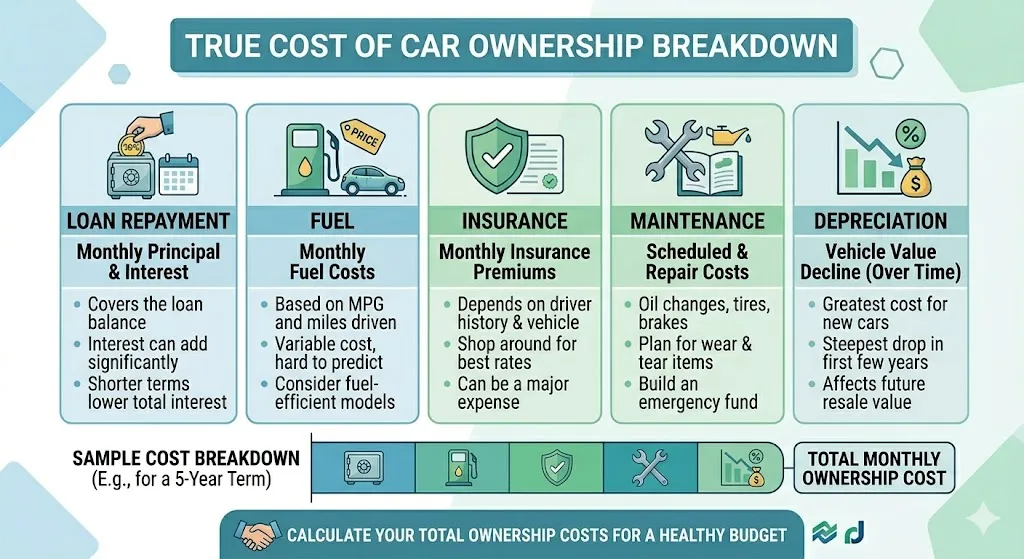
Car ownership costs go far beyond monthly payments—understand the full financial picture.
car, you can either pay cash for a car, or most people will probably put down a down payment and finance the rest. So, let's actually go over what that scenario looks like. Let's pretend that you have a prime credit score, so your average APR you're going to get on this car is 6.51%. We'll make a 20% down payment on this car, which is $7,980. And we're going to finance the car for the average loan term in the United States right now, which is around 6 years, so 72 months. That means your
monthly payments at a 6.51% interest rate is going to be $537 per month or about $38,664 over the course of 6 years. Now, here's the kicker. Of that 38.6K, you're paying $6,744 just in interest. And again, that's just the loan payment. And here's where most people actually stop calculating their true cost. But that's a huge mistake because we also have to factor in what our 72-month cost of insurance, maintenance, and fuel is as well. Luckily, you can look up these numbers for most car models on edmonds.com. And
I will link that resource down below for you guys. But for now, I filled this in for you for the sake of this article. So, insurance is going to cost you $8,640 over 6 years based on estimates. Fuel is just under $12,000 at 11,880 or about 165 bucks a month. and maintenance will run you 7272 over the course of 72 months. According to car edge.com, the RAV 4 actually holds its value really well. So after 6 years, it retains 68% of its value, meaning that you can resell it for about $27,43. That means your total cost to own this
RAV 4 over 6 years, if you add up all the costs and subtract the resale value is the following. You want to add up 7980 plus 38664 in payments plus the 86.40 40 in insurance, $11,880 in fuel, and 7272 in maintenance for a subtotal of $74,436. Subtracting the resale value of $27,43, you can see that your total cost to own this car over 6 years is $47,033. That's $7,839 per year to own this car. Now, what's really interesting with this number in particular, the 47K number, is that that's actually pretty good in the car
world. Your sticker price on the Woodland RAV 4 was $39,900, and you paid just over $7,000 extra over sticker to own the car outright over 6 years. That's not particularly great, but it could actually be a lot worse depending on the resale value of the car that you choose. Pretend that the residual value was 47% over 6 years instead of 68%. Now, 47% is actually a pretty common depreciation amount with most cars across the board. If that were the case, then your total cost of ownership over 6 years is just over
$55,500, which is 40% more than the sticker price of the car. But now, let's go over the leasing scenario. So, leasing is where you are basically renting the car for a period of three or sometimes four years. It usually comes with a cheaper monthly payment as well as less money due at signing. Now, if you didn't know this guys, in a lease, you're basically paying for the depreciation of the car over a set period of time. That way, the dealership takes the car back after your lease is over and then is able to sell
it on their own. For example, if a car is worth $30,000 and they know that at the end of 3 years, it's going to be worth $20,000 based on depreciation. Essentially, by leasing, you're paying for that $10,000 loss in value over those three years. Your monthly lease payment also covers two extra things. So, first is an interest or finance charge. and that charge is going to be determined by your car dealership's bank as well as broad economic factors like the current interest rate. The second
factor it also includes is any taxes and fees. Now, since you aren't buying the entire value of the car, leasing on a monthly basis is usually cheaper. But what about the true cost of ownership for the entire term? Let's get into those numbers. For our lease scenario, we will assume that we take out two backto-back three-year leases for a total of 6 years in order for an applesto apples comparison. In terms of money do it at signing, we'll assume $3,750 and we'll multiply that by two leases
Buying vs Leasing a Car: Full Cost Comparison Explained
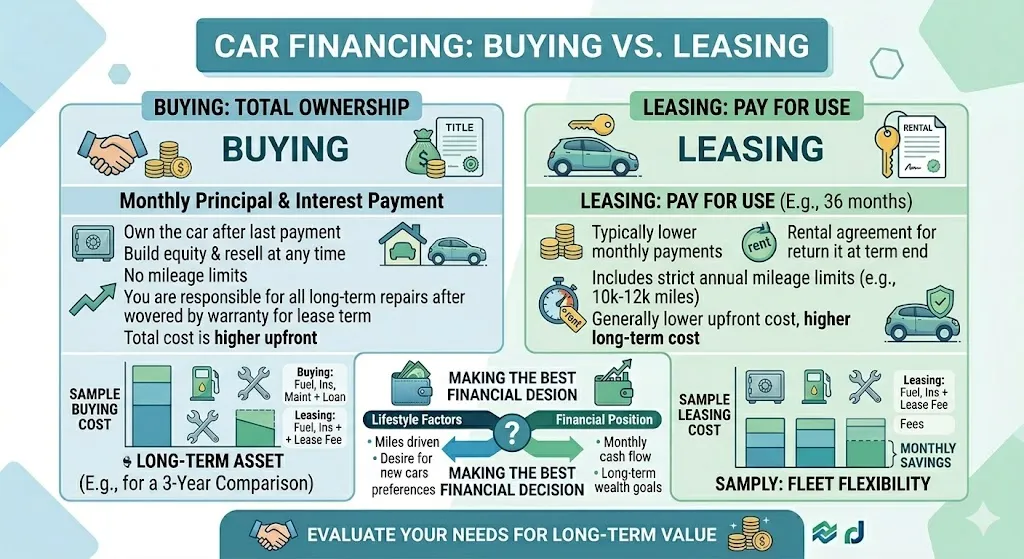
Compare total costs of buying versus leasing to make a smarter financial decision.
for a total of $7,500. That means your payment will be $450 a month for 72 months or about $32,400 over the course of these 6 years. You're still going to add in the same insurance and fuel costs as the buying scenario because that doesn't really change just because you're leasing the car. In terms of maintenance though, we are going to keep this at $0 because it's often included or covered with leases in general. So that means if you add up all of these numbers, that's a grand total
of $60,420 over the course of 6 years or on a per year basis, it will cost you $10,070 per year. The key difference here is that there is no resale value since you are turning the car back in and that in the leasing scenario, it will cost you $2231 more per year in order to drive this Toyota RAV 4. In other words, buying will save you $13,386 over the course of 6 years. Now, you actually might think, okay, well, article's over. We already figured out buying is better than leasing. Let's, you know, call it a day. But the actual
truth is that before you make your decision, we need to talk about the three scenarios where these numbers might change because not everyone's situation is the same. So, these three situations are the following. Number one, if you keep your car for 3 years instead of six. Number two, if you drive for way more than the average lease amount, so more than 12,000 mi. And number three, if your interest rates change either up or down. So going over number one, what actually happens if you keep the car for 3 years instead of six?
Does actually leasing get better at this point? So this is where leasing does look more competitive. Let's run the numbers to show you because there is something tricky about this entire scenario. For buying, you would still pay the $7,980 down payment. You'll have 36 months of payments at $978 a month, which totals $35,28. insurance and fuel and maintenance. These will all be half of the six-year cost because you're only doing it for 3 years. And that is $57,084 in total costs. Now, the RAV 4 holds its
value very, very well over 3 years. And it's going to be worth $32,319 at the end of 3 years, or the equivalent 81% residual value. So, your true cost over 3 years is going to be $24,765 or about 8.225 per year. for leasing over three years. I'm not going to say all the numbers, but they'll just be up on the screen. You can see that the total is going to be $30,210 or still $10,000 per year. So, even over 3 years, buying still saves you money, about $5,445, but the gap is smaller. But the key
number here, the very key number here is the resale value. The RAV 4 holds its value exceedingly well, 81% residual value after 3 years. But if the residual value is 60% over 3 years, like many of the cars out there, well, guess what? Leasing actually is cheaper by about $2,900ish. So, when it comes to buying versus leasing a car for 3 years and 3 years only, you really need to pay attention to the numbers and run them yourself. Sometimes buying could be cheaper, but other times leasing could be cheaper.
How Car Leasing Works: Understanding Payments and Depreciation
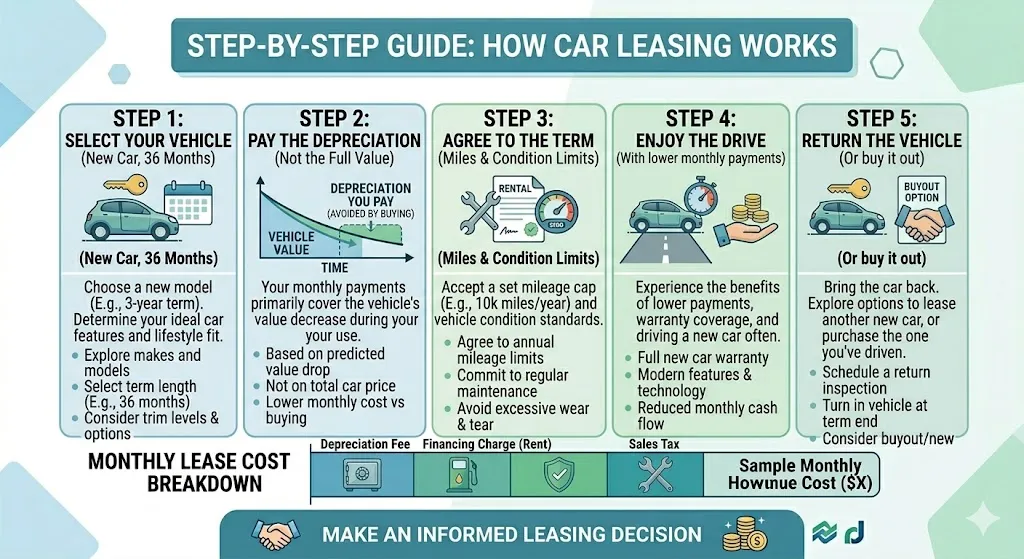
Leasing means paying for depreciation—not ownership—over a fixed term.
But I will say the nice part is is that if you buy a car after 3 years, at least you own an asset versus if you lease the car, you have nothing to show for it at the end of 3 years. Now, let's get into the second scenario where perhaps you drive more than the average person does or you drive a lot more than what your lease terms come with. Standard leases are usually 10 or 12,000 m per year. If you exceed that, you generally pay between 15 to 25 cents per mile in overage fees. So, let's pretend you
drive 18,000 mi a year instead of 12,000. That's going to be 6,000 extra miles. And at 25 cents per mile, that's going to be about $4,500 in fees extra per lease. If you did that for two leases back toback, so six total years, that would be an extra $9,000 in fees on top of the original amount that we calculated, and that just means leasing becomes significantly more expensive. So, if you're somebody that just understands themselves and just knows that, hey, I might drive more than the
mileage limit or more than 12,000 mi, I would probably stay away from leasing. Now, the next scenario that's going to be very applicable to you, especially if you're watching this in the future, is if interest rates change. For today's article, we used a 6.51% interest rate in our scenario, but let's say in the future interest rates drop to 4.5%. Your monthly payment will drop about $30 a month to $507 a month, and that will save you about $2,160 over 6 years. The lower the interest
rates get, typically, the better it becomes to finance a car. However, let's examine the opposite situation, which is the interest rate environment, where you might get an 8.5% interest rate. In that case, your monthly payments would balloon up to $571 per month, costing you an extra $2,448 over the loan term in our scenario with the RAV 4. Buying a car in this scenario actually still wins out because you own the asset at the end of the day, but the math becomes less favorable over leasing. All right, some of you watching
might have watched all of this and say to yourself, "Okay, but I still want to lease a car every 3 years because I'm going to get new technology within the car. I don't really have to worry about repairs, and the warranty really covers a lot of everything." And I'm not actually here to tell you that you were wrong for doing that. Leasing might actually make sense in a few different situations. For example, if you're running a business and you can write off a lease payments, then perhaps the tax
Key Factors That Impact Buying vs Leasing Decisions
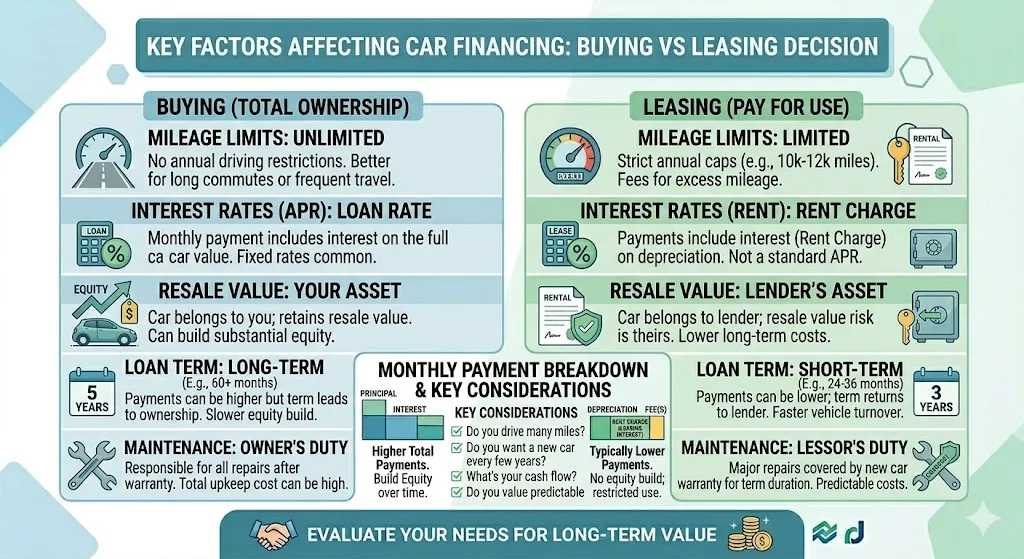
Your driving habits, interest rates, and resale value can change the best option for you.
benefits might offset the higher costs. Another example I thought of is that if you have a job where your image matters a lot, so let's say you are a realtor, you're in sales, or maybe you're a consultant or something. If you want to project success and image, then having a new car every 3 years might be a business investment. Lastly, if you're somebody that just knows you're going to get bored every 3 years, you're one of those people that also enjoy cars and you value peace of mind, then paying
more for convenience and having a lease is perfectly fine. I've been personally reading a book lately about the art of spending money by Morgan Hel. And in it, he says that everyone has different values based on their upbringing. Those values really drive how people spend money. So, it's not for me to say whether or not a lease decision is good or bad for you or not. This article is made to serve you so that you can make the choice with your eyes open about what the potential costs are going to
be. Now, this article would not be complete if I didn't share with you guys what I personally would do when I'm buying a car. The first option I would go for is to try to buy a car in cash if I have the budget and I could afford it. There's going to be some comments of you guys saying, "Yeah, but Humphrey, you could just finance the car and then invest the difference." I think though at the average interest rates of around 6.5% that the decision is really close between just buying the car outright and
investing the difference of that money. The stock market averages about 8% per year and while yeah you might be able to make more in the stock market, I would prefer a guaranteed return on my money. So if a car loan is going to cost me 6.5%. I'm just going to pay it off in full if I have the money on hand. All right, but what if I am financing a car or contemplating putting some money down and then taking on a monthly payment? If that were the case, I'm going to make sure that I buy a reliable car,
Smart Car Buying Strategy: How to Minimize Long-Term Costs
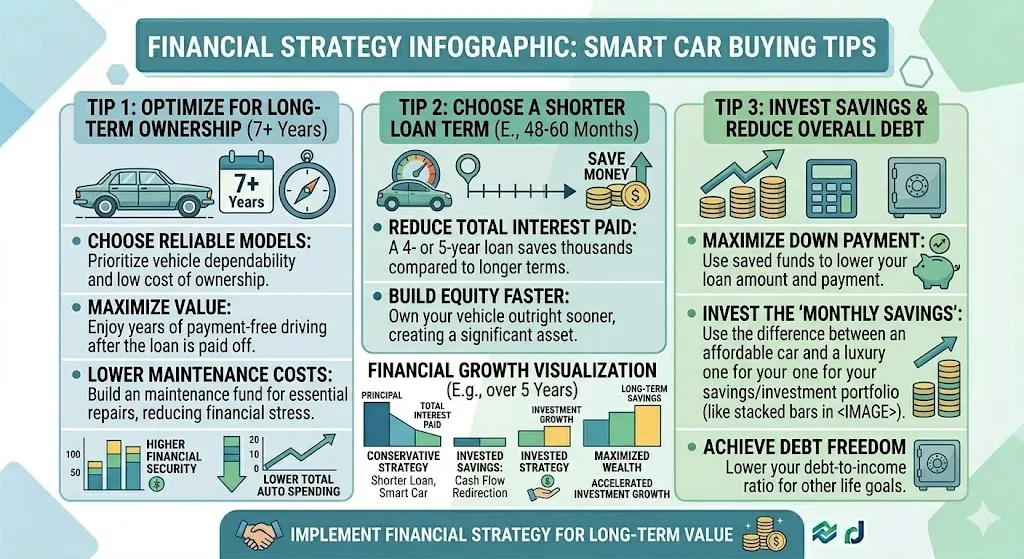
Use proven strategies to lower your total cost and build wealth over time.
something like the Toyota RAV 4 that holds its value very well. Then what I want to do is finance it with the shortest term that I can afford possible. Now, this is the actual key of owning a car. I'm going to keep the car as long as I can and drive it into the ground. Hopefully, that's 10 years, maybe 12 years instead of six because if you're able to do that, then your cost per year drops dramatically. Another thing that people don't really talk about is that when you get to the point
where you're done paying off your car, you want to take any extra money that would have gone towards your car payment and invest it instead. That's a really good wealth hack because when you have no car payment, you really want to take advantage of that. All right, so I think most people will underestimate the true cost of their decisions over their lifetimes, but I hope that this article enlightened you a little bit, at least in the car buying scenario. If you're interested in another article about cars,
📘 Auto Loan Mastery Guide
Everything you need to know before signing any car loan
20+ Chapters • Instant PDF download
$4.99$24.99
- ✅ Why financing a car can be smarter than paying cash
- ✅ How much car can you REALLY afford? (Avoid being house-poor on wheels)
- ✅ Boost your credit score fast before applying
- ✅ New vs Used Car Loans – Which one saves you more?
- ✅ Dealer financing vs Bank/Credit Union – The hidden truth
- ✅ Fixed vs Variable rates explained simply
- ✅ Complete step-by-step car buying process + pre-approval checklist
- ✅ Hidden fees, dealer tricks, negative equity & Gap insurance explained
- ✅ Leasing vs Buying – Clear comparison with pros & cons
- ✅ How to negotiate the best deal and refinance later
- ✅ Plus: First-time buyer checklist, documents needed, and final tips to avoid buyer’s remorse
🔥 Perfect for first-time buyers and experienced drivers who want to save thousands
🛒 Buy Now – Instant Download🔒 Secure checkout • Lifetime access • 30-day money-back guarantee
Try Our Calculator
Use our online calculator to estimate results instantly.
Open Calculator